
Knee Pain · Clinical Insight · 5 min read · June 2026
Why most knee pain after 50 doesn't get better — and what a British orthopaedic surgeon does about it
After 20 years operating on knees, I've come to believe most of my patients never needed to be on my table.

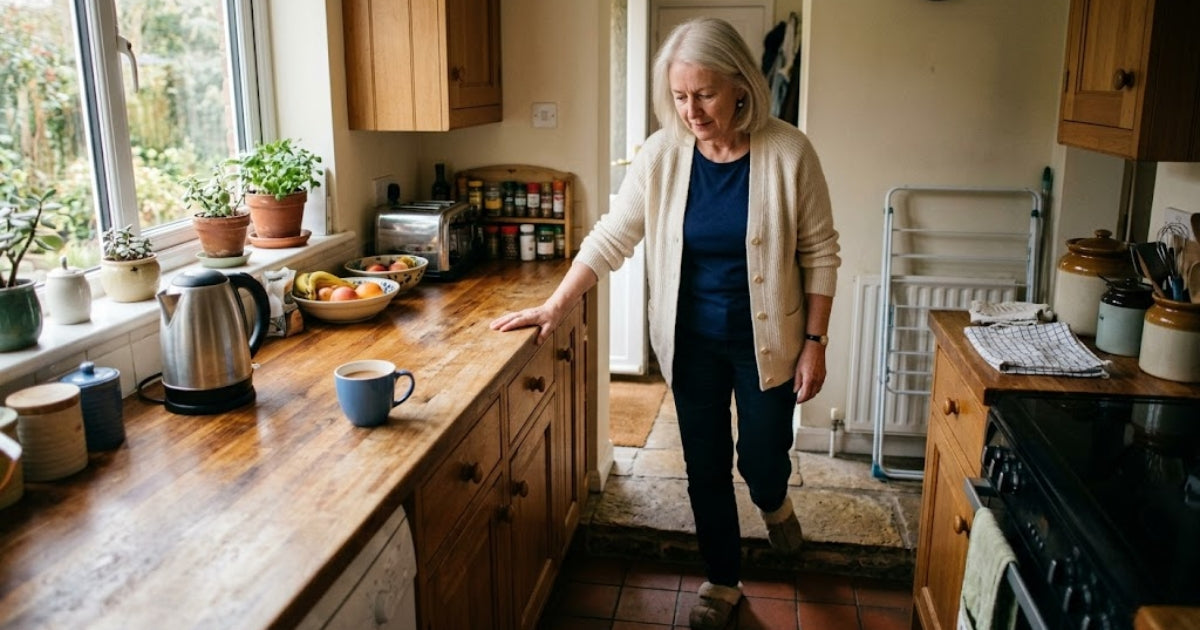
If you're reading this, your knee has been running your life for a while now.
You think about the stairs before you climb them.
You pick your chair by how hard it'll be to get back up.
And the mornings? The first few steps are the worst — that stiff, grinding start before things loosen off.
The garden. The dog. Getting down to the grandchildren and back up again.
The ordinary things have quietly become things you weigh up first.

And you've already had a proper go at the obvious answers.
Paracetamol. Ibuprofen gel of an evening. A support from the chemist.
Maybe physio that helped for a fortnight, then tightened back up.
Maybe your GP has mentioned a referral — and you've seen the waiting lists. Around 49,500 people are currently waiting for a knee replacement, with an average NHS wait of 28.7 weeks.
So now you're stuck in the worst spot of all:
Too sore to get on with life properly. Not so far gone you're ready to hand over a year to surgery.
I've sat across from this patient hundreds of times.

"I just want it sorted. I'll book the surgery if that's what it takes."
Last winter, Margaret sat in my clinic.
Two knees getting worse for three years. GP, two lots of physio, one steroid injection — then me.
I told her what I tell most people in that chair.
Surgery for worn knee pain after 50 is the last option. Not the first.
In her case — as in most — the real problem wasn't a joint that needed replacing.
It was a circulation problem.
The hidden reason your knee won't settle
Here's what most people are never told about an ageing knee.
Your knee depends on a steady supply of blood — oxygen, nutrients, and the cellular machinery that clears inflammation and rebuilds what daily wear breaks down.
At 30, that supply turns up on demand. You tweak the knee gardening, the body repairs it overnight, you never notice.
After 50, that supply quietly dries up. By your 50s, resting blood flow to the legs can be around 25% lower than in younger adults.
The structure is still there. The supply line that keeps it self-repairing is not.
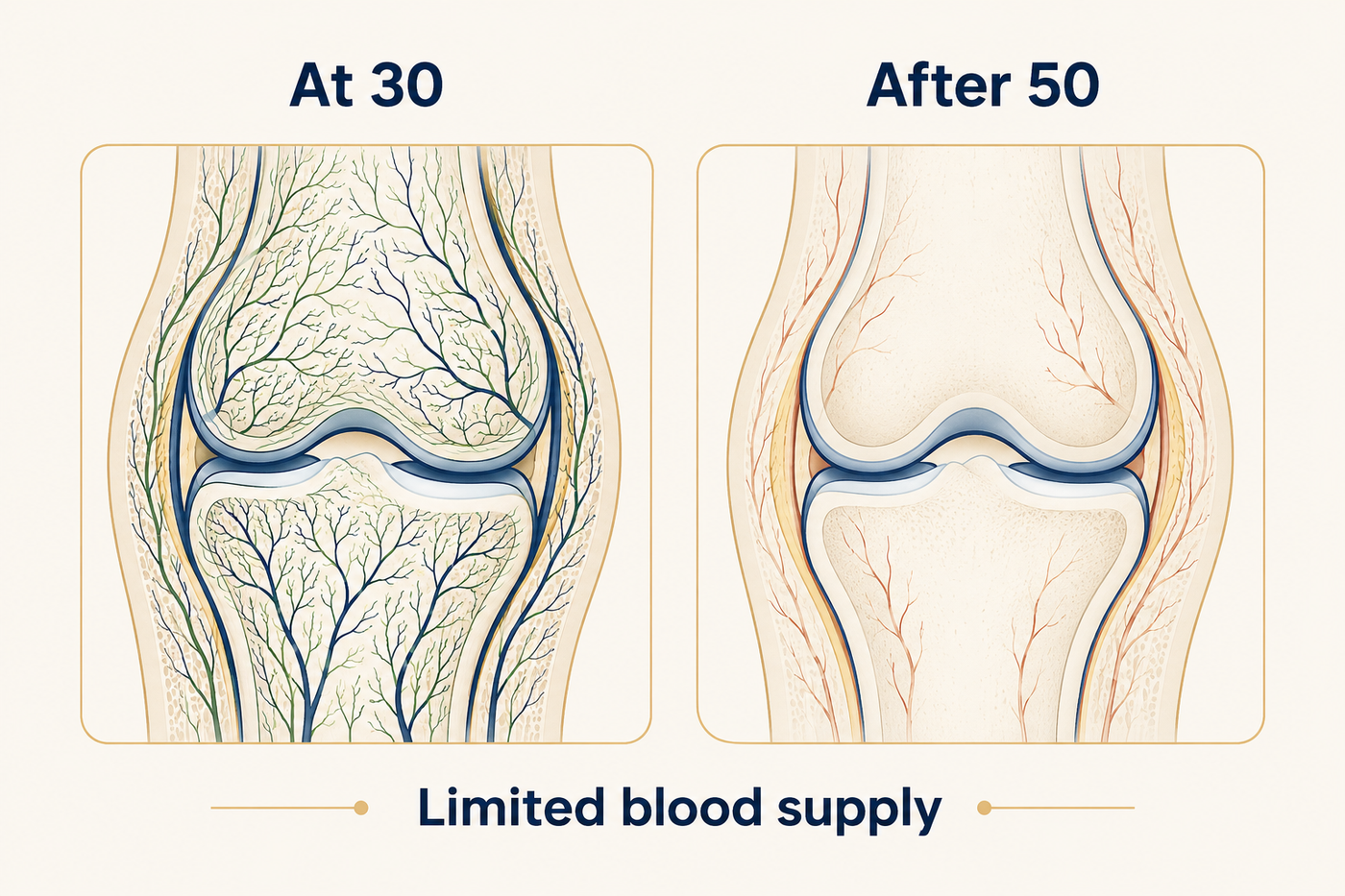
You haven't worn your knee out. Your knee has been quietly starving for years.
So the small wear-and-tear that repaired itself at 30 simply… doesn't, at 60.
The damage builds up. The inflammation lingers, because there's no flow to clear it.
And a knee that used to recover overnight becomes a stiff, aching, every-single-morning one.
Once you see that, the reason nothing has worked starts to make sense.
Why everything you've tried falls short
Painkillers and gels
Mask the signal. They don't restore circulation. The ache comes straight back.
Steroid injections
Quieten things for a few weeks. They don't touch the cause — and you can't keep having them.
Physiotherapy
Strengthens the muscles. Genuinely helps. But it can't rebuild the circulation the joint has lost.
Heat packs
Warm the skin and stop there. The joint sits far deeper. Feels lovely. Does almost nothing where it counts.
None of these failed because they were done badly.
They failed because the tissue was already starving — and none of them feed it.
What actually helps
The answer isn't to replace the knee.
It's to get circulation back into the joint so it can do what it's built to do — repair itself.
There are three ways to do that deeply, at home. Each one is standard in any sports-medicine clinic in the country.
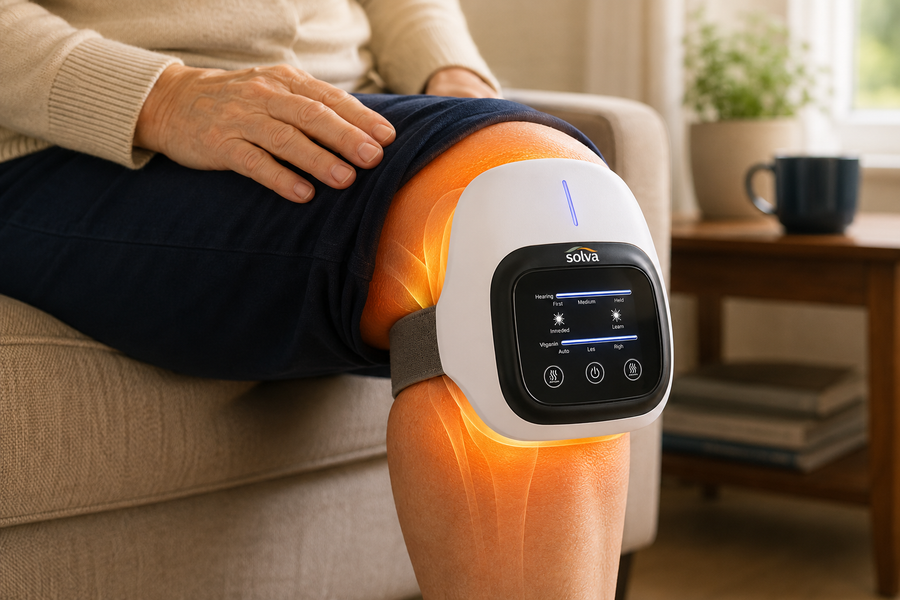 42°C Precision Heat01
Open the circulation
Sustained, regulated warmth that reaches past the skin into the deeper tissue around the joint — and opens the circulation that's been sluggish for years.
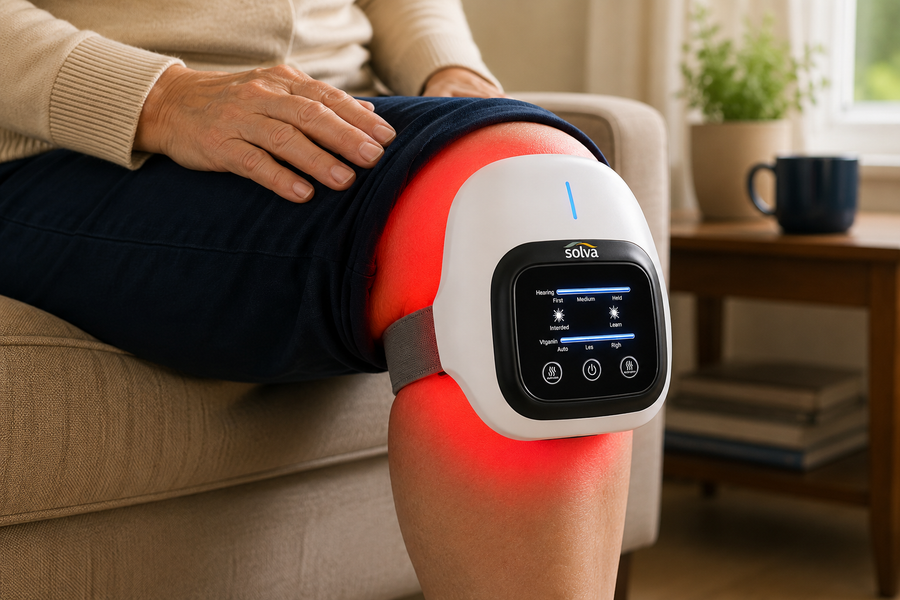 Red Light Therapy · 660 & 850nm02
Wake the cells
Specific wavelengths reach the cells around the joint and wake up the repair machinery age switched off. The part a heat pack can never do.
 60Hz Targeted Vibration03
Drive it deeper
Gentle vibration drives the warmth and light deeper, loosens the morning stiffness, and keeps fresh blood cycling through the joint.
The three have to run together. In one session. At the same time.
Heat alone opens the circulation — but doesn't wake the cells.
Light alone wakes the cells — but they can't work without fresh blood.
Vibration alone reaches deep — but the tissue can't use it without the other two.
Run all three at once, ten minutes a day — and the knee finally gets what it's been starved of.
What I tend to see — 10 minutes a day
What I tend to see in clinic, with daily use:
-
Session 1Warmth comes through within a minute. Most say the knee feels "looser" by the end.
-
Days 7–14The grinding morning start eases. Stairs stop being the thing you dread.
-
Weeks 4–6People start doing what they'd quietly stopped — the longer walk, the garden, the floor with the grandchildren.
-
Day 90For most, the knee is simply no longer the centre of the day.
The device I now suggest people try first
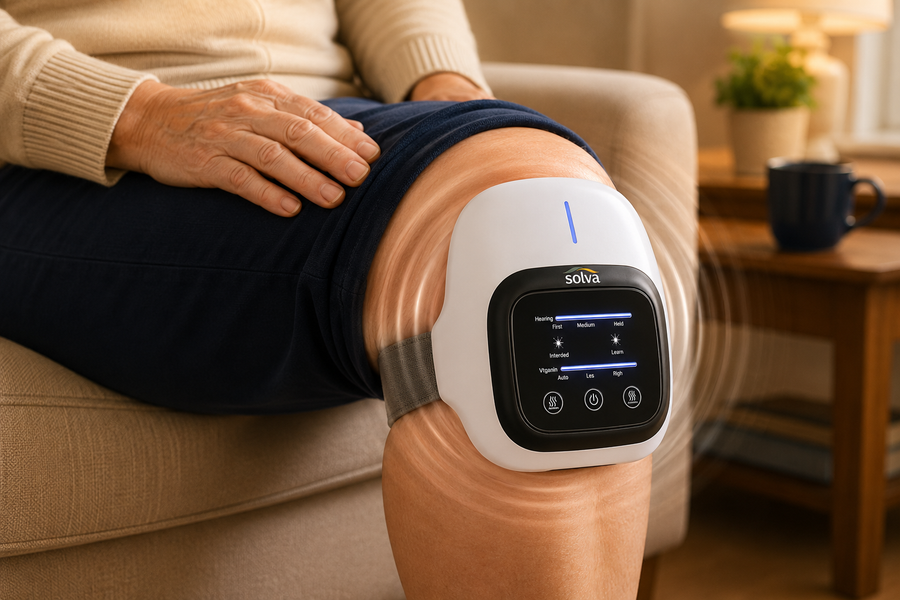
A year ago, I started recommending a device built to deliver all three therapies — heat, red light and vibration — in one ten-minute session at home.
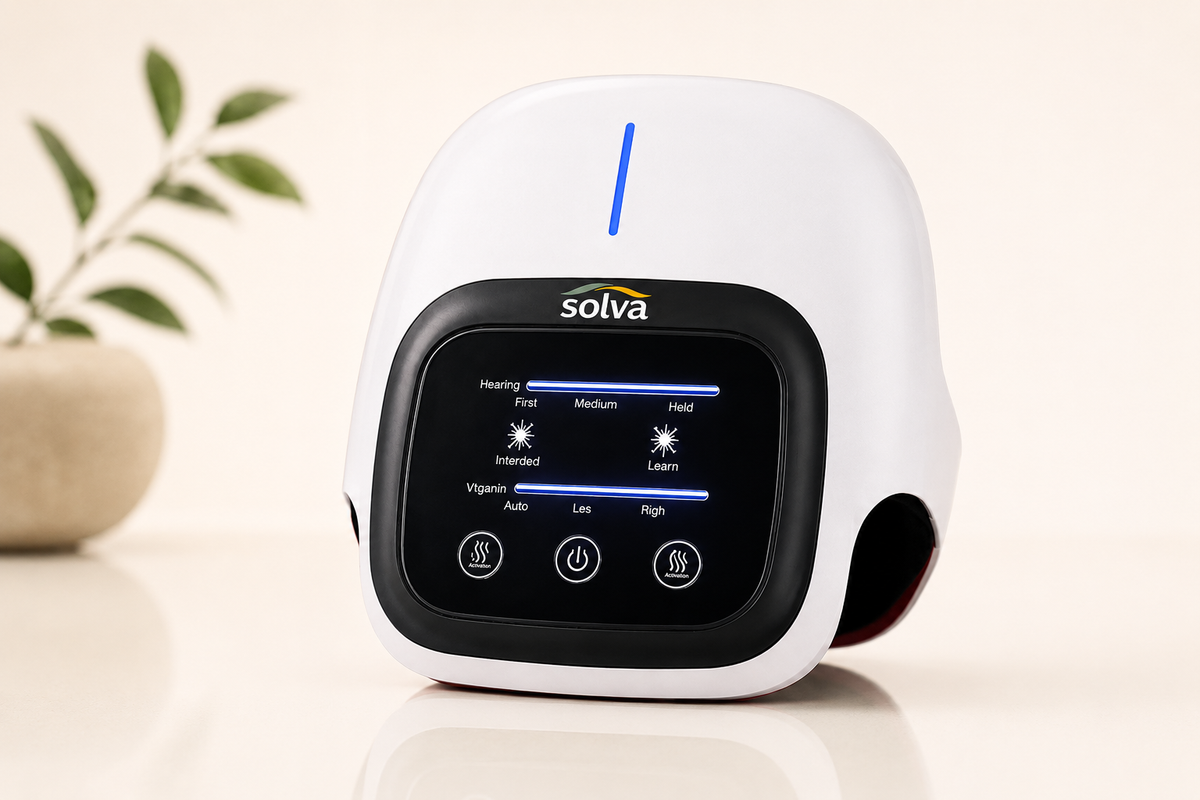
Solva Knee Recharge Pro
3-in-1 Heat · Red Light · Vibration Therapy · 10 minutes a day
It's a wrap that straps around the knee.
One control unit. One button.
All three therapies together, ten minutes, then it switches itself off.
Once a day, in your own front room, with a cup of tea and the telly on.
I started suggesting it to the people I felt shouldn't be rushed into surgery — people like Margaret.
She used it once a day for six weeks.
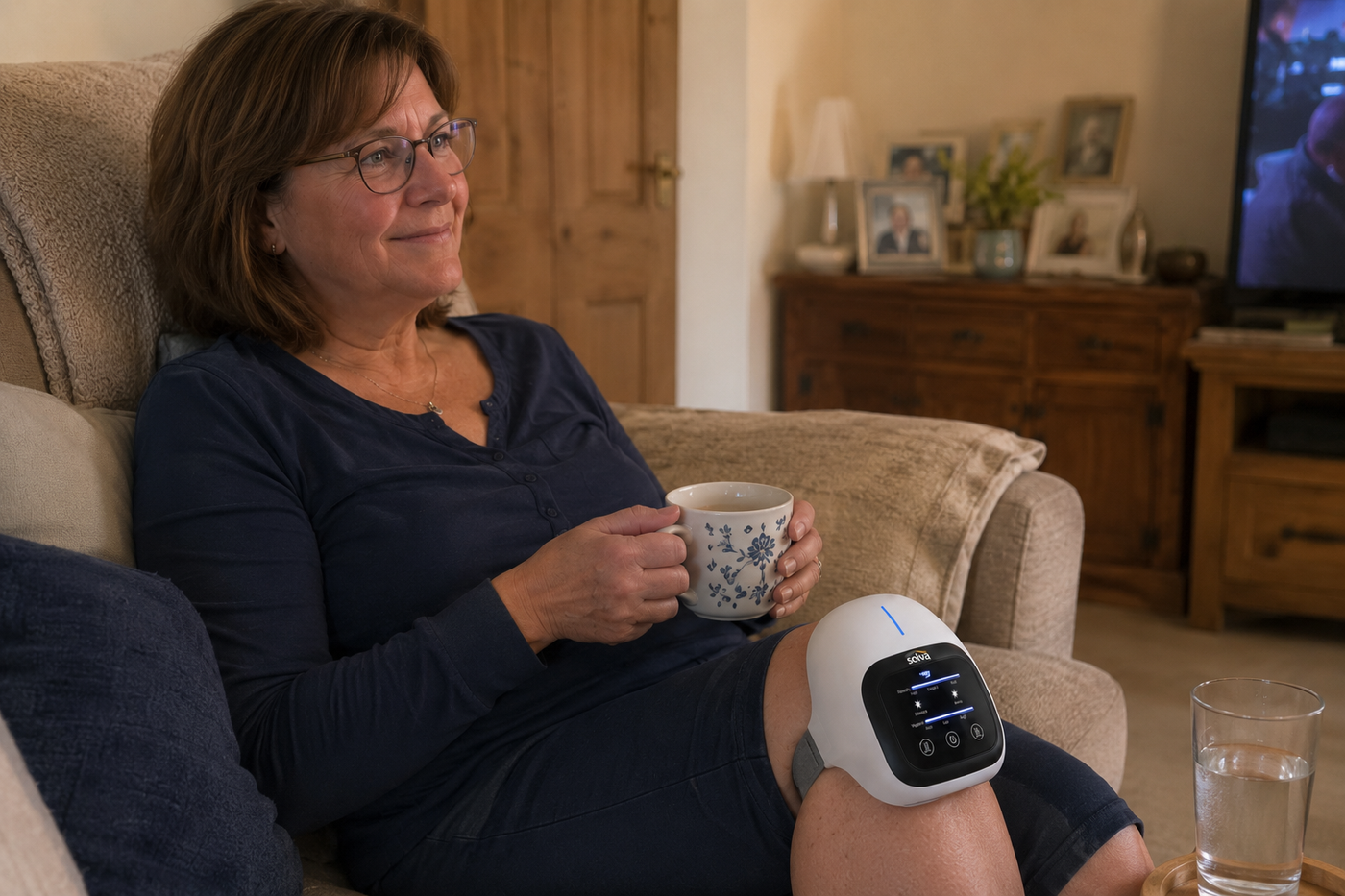
When she came back, she said nothing for a moment.
Then she stood up — without reaching for the armrest — and looked at me.
"I haven't done that without thinking in two years. I didn't book the surgery."
She hasn't booked it since.
What it is — and what it isn't
It is not a cure. Not a replacement for surgery when surgery is genuinely needed. Not a magic device.
It's a practical tool — three established therapies, delivered together, daily, at home — for the slow-onset, won't-go-away knee pain that physio can't quite settle and painkillers only mask.
For the people I see in their 50s, 60s and 70s, whose knees simply needed feeding again — it's done what the gels and injections never could.
Free tracked UK delivery. With a 90-day money-back guarantee.
A fair trial. The full window for real change.
Use it daily for 90 days. If your knees aren't moving easier, starting the morning easier and letting you sleep easier — every penny comes back. No forms. No store credit. No fuss.
If surgery is the next step — try this first
If you've been told surgery is the next step — and you haven't booked it yet — this is what I'd ask you to try first.
It's the option that comes before the operating theatre. It gives the joint a chance to repair itself, while you still have that chance.
Most patients tell me they wish they'd known about it a year ago.
Free UK tracked delivery · 90-day money-back · Pay securely by card or PayPal

What readers are saying
Three weeks in and the stairs first thing aren't the battle they were.
One each for me and the wife. Ten minutes with the football on, done.
Sceptical, me. But mornings are easier and I've stopped reaching for the ibuprofen.
Bought it for my dad, 78. He's out with the dog again.
Not a miracle. But the best thing I've tried — and I've tried the lot.